
Origin of Fort Chillon and its companies 1942–1995
Cap Christian Welter
Dernier commandant de la
cp ouv 55 et du fort de Chillon
The SUD threat
In the 1930s, the threat from the south was a reality for Switzerland. We now know that, during their meeting at the Brenner Pass, Hitler and Mussolini had divided Switzerland between them. In its first version from 1935, the OKW’s Tannenbaum plan envisaged a German attack involving 15 divisions, whilst the Italians planned for 30. Along the Grand St Bernard penetration axis, the distance between the border at the pass and the exit onto the plateau at the outskirts of Vevey is 94 km, and 20 km from St Gingolph.
Switzerland had heavily fortified the defences along this axis. In its final form, the defences comprised, in addition to the troops stationed in the sector and the mined fortifications, three fortresses: Champex, Comeire and Follatères. Between Martigny and St Maurice, two companies of fortifications each barred the Rhône valley. Next came the St Maurice barrier and the Chillon defiance.

The design of the Chillon defensive position
The topography of the Chillon Gorge is highly conducive to defence. Between the lakeshore and the mountainside, a 40-metre-wide strip of land provides space for a double-track railway line and the cantonal road. Apart from a forest track crossing the fort’s superstructure and the third-class road to Sonchaux, situated much higher up, the mountainside is impassable to vehicles and very difficult for infantry to advance along.
The development of the defensive position at Chillon took place in several phases. In 1940, a field fortification was built in the castle gardens on the Villeneuve front, equipped with two 7.5 cm infantry guns and a machine gun. This fortification was dismantled in 1945.
The original Chillon Fort was built in 1941–1942 and handed over to the troops at that time. The defensive position was designed symmetrically, enabling it to be deployed towards Montreux against an enemy approaching from the plateau, and towards Villeneuve against an enemy coming from Italy or Savoy and seeking to penetrate the plateau. In 1942, work to reinforce the site focused on the railway line and the cantonal road. The motorway viaduct was added later.
The main elements of the defensive position were the mined fortifications, initially two in number and later four following the construction of the motorway viaduct: towards Montreux, the railway-cantonal road minefield at Veytaux station, the anti-tank barricade and the motorway minefield; and towards Villeneuve, also a railway-cantonal road minefield, the anti-tank barricade and the motorway minefield. Each section of the road-side and railway-side minefields was under fire from a casemate equipped with a 9 cm anti-tank gun and a machine gun. All the fort’s other weapons were used for its external defence. The embrasures of the four main casemates were either inaccessible to infantry or under fire from a machine gun or a soldier with an assault rifle, protected within a small fort or a solitary post.
In 1960, the interior layout of the fort was altered. The casemates, however, remained unchanged.
From 1942 to 1977, the company’s mission at Chillon was twofold: an infantry-type mission involving blocking and holding the Chillon defile, and an artillery-type mission, providing artillery fire across the lake and onto the opposite bank. From 1978 to 1995, the mission remained that of blocking and holding.

A Maginot-style design
The fort was built in accordance with the design principles of the time. The garrison fought from casemates or pillboxes, protected by reinforced concrete. The superstructure was protected by a triangular network of barbed wire. At its summit stood the Champ Babau fortlet, which also housed the mine-launching half-section. Seven other fortlets provided flanking fire along each segment of the barbed-wire network. As with the Maginot Line, the forts provided mutual cover to enable ‘sweeping’. The forts at Savatan and Dailly provided cover for the superstructure of Champillon Fort. Champillon, at the limit of its range, provided cover for the superstructure of Chillon Fort. Chillon’s two 7.5 cm artillery guns provided fire support across the lake for the Fenalet barrage position, on the opposite shore, at the exit from St-Gingolph towards Le Bouveret.
The 7.5 cm artillery guns were field guns whose carriages had been modified so that they could be used as fortress guns. They remained in service until 1978. The fort had its own command post.
The fort had a large telephone exchange. It was connected by wire to all the key parts of the fort, to all the casemates and firing positions, to all the small forts, to the numerous FAKs (Feldanschlusskasten) in the superstructure and in the surrounding area, as well as to the other fortifications in the Chablais sector.
Le fort a été conçu afin de disposer d’une autonomie « suffisante ». Raccordé aux réseaux locaux d’eau et d’électricité, il disposait en plus d’importants réservoirs d’eau de de diesel. Il était aussi possible de s’approvisionner en eau du lac. Dans la salle des machines deux moteurs marin diesel fournissaient au besoin l’électricité nécessaire. Le fort aurait donc pu vivre en autarcie. Des ventilateurs et de grands filtres N et CO permettaient de filtrer les gaz de combat et le CO. En créant une surpression il était possible de faire du casernement une zone protégée. Mais la très faible capacité de passage du sas n’aurait pas permis, en cas de combats, de la maintenir en fonction.
The engine room also supplied fresh air to the gun positions, which, when firing, would have released large quantities of toxic CO. All gun crews are said to have worn their protective masks whilst firing and to have been connected, via long hoses, to the fresh-air supply system.
The barracks were fully equipped. The fort had an infirmary with a proper operating theatre. When the new concept for medical care for the troops was introduced, based on the civilian hospital infrastructure, the operating theatre was decommissioned. However, the company retained its medical officer.

Personnel and weaponry
In its final period, as Construction Company 55 (CP Ouv 55), the strength at Chillon stood at 252 men:
9 officers, including one medical officer
23 senior non-commissioned officers and non-commissioned officers
220 soldiers, including those in the mined fortifications
The total strength of the 55th Engineering Company was higher, as, during training, the small forts belonging to the Vouvry and Grande Eau fortification groups were also under its command.
The fort’s armaments, like the rest of its equipment, were modernised throughout its period of operation. In its final phase, the fort’s armaments consisted of
4 structures with mines
4 × 9 cm 50/57 anti-tank guns on fortress mounts
13 7.5 mm 51/60 machine guns on fortress mounts
2 mobile 8.1 cm mine launchers 33
6 × 8.3 cm rocket tubes 80
6 assault rifles with scopes
les armes personnelles de la garnison
The first batch of ammunition for the machine guns was kept in metal boxes at the firing positions, ready to be loaded onto belts. The anti-tank shells and the rest of the ammunition were stored in the ammunition store.
The companies at Chillon 1942–1977
When the fort was commissioned in 1942, the company stationed at Chillon was Fortress Artillery Company 9 (FAC 9). In 1944, Fortress Artillery Group 4 (Fortress Artillery Group 4) was formed, and the company at Chillon became Fortress Company II/4. Fortress Company I/4 and the headquarters of Fortress Artillery Group 4 were located in the Champillon fortification. In 1978, following the reorganisation of the fortress troops, the 7.5 cm artillery guns were removed from the fort. The company at Chillon became Ouv 55/Wk Kp 55 (Ouvrage 55/Werk Kompagnie 55), a fortress infantry unit.
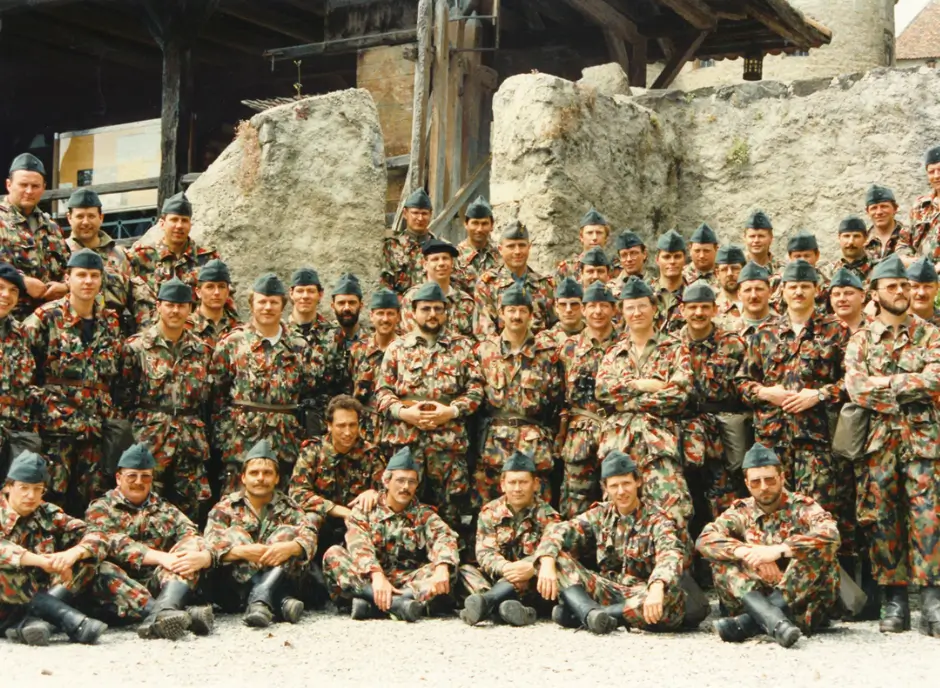
The final phase, 1978–1995: cp ouv 55/Wk Kp 55
By 1978, the forest had reclaimed the superstructure and the barbed-wire fence had almost completely disappeared. As it was unrealistic to expect the fort to be restored during a wartime mobilisation, the last remaining traces were removed between 1980 and 1982. As the armour of tanks and the range and accuracy of their guns had improved enormously, the protection offered by the casemates and the effectiveness of the fort’s anti-tank guns had greatly diminished, even at short engagement ranges. The fort’s Maginot-style defence strategy had had its day.
In the mission analysis, the key areas remained the mined structures and their detonation systems, as well as the fort’s embrasures and access points. The role of the 55th Engineer Company became that of an infantry company fighting in extremely difficult, rugged, steep and forested terrain. As the fort’s defences played an increasingly secondary role, the platoons fought out in the open. During each refresher course, a dual-action infiltration exercise was used to test the fort’s various defence sectors. ‘The enemy’ was always made up of the company’s best men, and the motivation of both the attackers and the defenders was high. Even with their perfect knowledge of the terrain, the attackers never managed to achieve their objectives.
The brief analysis above of enemy capabilities has not covered air attacks from the lake, helicopter operations in the vicinity of the fort, smart missiles or the use of chemical weapons. Nor has it covered the possibility of reinforcing the defences with additional resources in the event of combat.
A modern museum
The Chillon companies and the fort have gone down in history. It is fortunate that, since 2020, a modern, interactive museum open to all has ensured the preservation of this history and enables today’s visitors to discover, whilst enjoying themselves, the extent of the Swiss defence efforts during decades fraught with danger.
Introduction to Captain Christian Welter
Christian Welter was born in 1946 in Poland, the son of a Swiss mother and a career Polish officer, who had fought in Poland in September 1939 and in France in June 1940, and had been awarded the Virtuti Militari and the Cross of Valour. In 1955, the family returned to Switzerland. Having become a naturalised Swiss citizen, Christian Welter qualified as an ETH engineer and served as an officer in the 10th Engineer Battalion. From 1980 until its disbandment at the end of 1995, following the 1995 army reform, Christian Welter commanded the 55th Engineering Company. He is married and has three adult children.