
Chillon in the Middle Ages – A fortified castle at the heart of Savoyard power (11th–15th centuries) 1/5
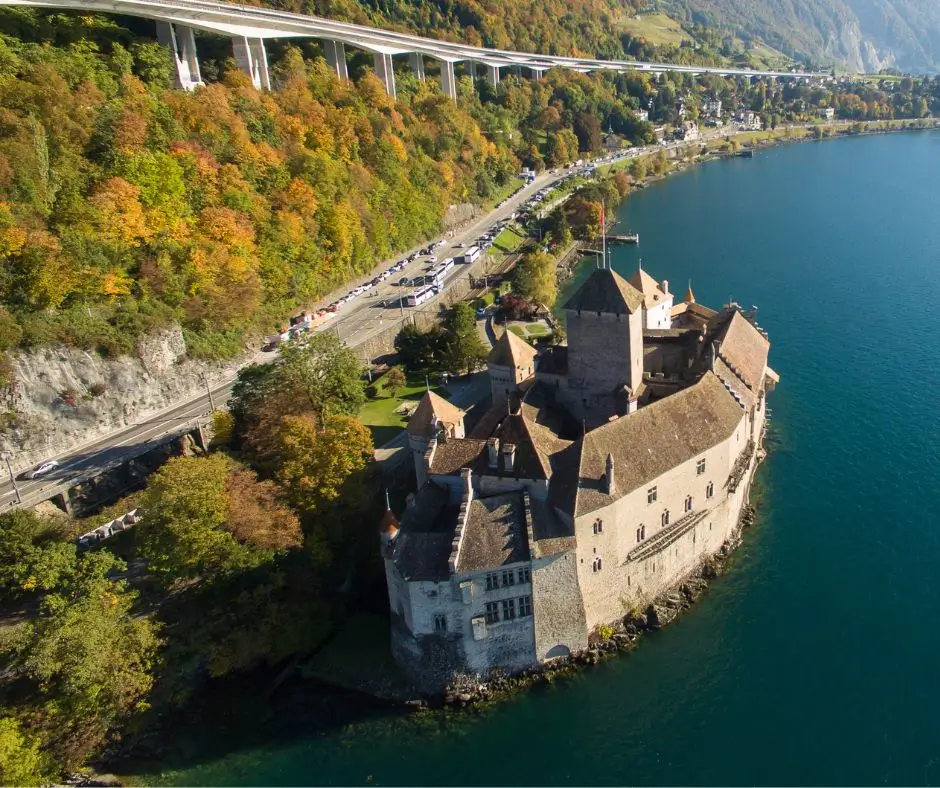
Perched on its rock on the shores of Lake Geneva, Chillon Castle is much more than a romantic setting: it bears witness to more than eight centuries of strategic and political history. Since the 11th century, this site has dominated the passage between northern and southern Europe. Through the major phases of construction and power, discover how Chillon became the stronghold of the Counts of Savoy, then the key to the bailiwick of Chablais, while Villeneuve was born as a “new town” to control the lake and trade.
A strategic site since ancient times
The rock of Chillon, overlooking Lake Geneva, was occupied very early on due to its position on the road to Italy and its naturally defensive location. Excavations have unearthed objects from the Bronze Age, attesting to an ancient defensive function, probably in the form of a double palisade. The Romans in turn fortified this crossing point, and the rock was given a square keep in the 11th–12th centuries, probably as part of the domination of the Counts of Savoy.
Before 1150, Chillon passed from the control of the bishops of Sion to that of the counts of Savoy, who made it their oldest stronghold north of Lake Geneva. The first explicit mention of the castle dates from 1150, in a charter in which Count Humbert III of Savoy granted the monks of Haut-Crêt free passage to Chillon.
Savoy builds a fortified castle (12th–15th century)
In the 12th century, the Counts of Savoy undertook major reconstruction and expansion work, giving Chillon its current form as a fortified castle. The site is organized around three courtyards, with separate areas for the fortifications, the castle keeper's residence, and the prince's residence. The Saint-Georges Chapel, located between the fortifications and the private apartments, was decorated in the 14th century by a painter who may have come from Italy, Master Jacques, with an iconographic cycle based on the genealogy of Christ and the Redemption.
Work continued in the 13th century under Amédée IV, Pierre II, and Philippe of Savoy, who reinforced the second wall with towers and new techniques for concentrating defenses. Under Peter II, architect Jacques de Saint-Georges built the “châtelain” room, with its two oak columns crowned with hooked capitals. From the 14th century onwards, the lower rooms and underground passages were converted into prisons, which remained in use until 1895.
Villeneuve de Chillon: the “new town” on the lake
In 1214, Count Thomas I of Savoy founded Villeneuve de Chillon, a new town located east of the castle, which would eventually replace the old village of Chillon. This foundation served a dual purpose: to house the growing population dependent on the castle and to control commercial traffic on the lake. Villeneuve became an agricultural and lakeside town, endowed with a charter and a toll, and drew its prosperity from trade and viticulture.
The old toll accounts of Villeneuve (1283–1293) are among the oldest preserved accounts of medieval towns in Europe, bearing witness to an economy structured around the lake and mountain roads. The church of Compengie, mentioned as early as 1166, was replaced by the current church, which became a parish church in 1228 and was converted into a temple in 1536.
Chillon, center of the bailiwick of Chablais
Chillon, center of the bailiwick Chillon served as an occasional residence for the counts and later dukes of Savoy, but also as the permanent seat of the bailiffs of Chablais, who were also lords of Chillon. The castle became the center of a castellany and the capital of the bailiwick of Chablais, controlling a territory stretching from Conthey to Versoix, including Geneva, the southern shore of Lake Geneva, and Aigle.
The castle played a key role in Savoyard politics: it served as a fortress, prison, granary, and checkpoint for the roads north and south of the Alps. This strategic position explains why Chillon was one of the first targets during Bern's conquest of the Pays de Vaud in 1536.
Sources
-
Dossier pédagogique « À l’abri des murailles : la vie d’un château à l’époque savoyarde », Fondation du château de Chillon, 2008.
-
Article « Chillon, château de » dans l’Histoire de la Suisse (HLS-DHS-DSS), 2005.
-
Article « Villeneuve (VD) » dans l’Histoire de la Suisse (HLS-DHS-DSS), 2017.
-
Site officiel du château de Chillon, sections « Histoire » et « Le château en quelques mots ».
-
Site officiel de la ville de Villeneuve (VD), section « Histoire ».
5 Articles in this series:
The Military Fortress of Chillon – A 20th-century fortress (1941–1994) 4/5
Chillon and its region from 1900 to 1995 – Heritage, tourism, and memory 5/5