
Villeneuve and the Chillon region – From lakeside village to tourist center (13th–19th centuries) 3/5
Villeneuve, “the new town” founded in 1214, is much more than just a stopover between Switzerland and Italy: it is an economic, administrative, and cultural center in the heart of the Vaud region on the shores of Lake Geneva. Discover the history of Villeneuve, from its medieval toll booth to its tourist boom, via viticulture, lake trade, and the birth of the seaside resort.
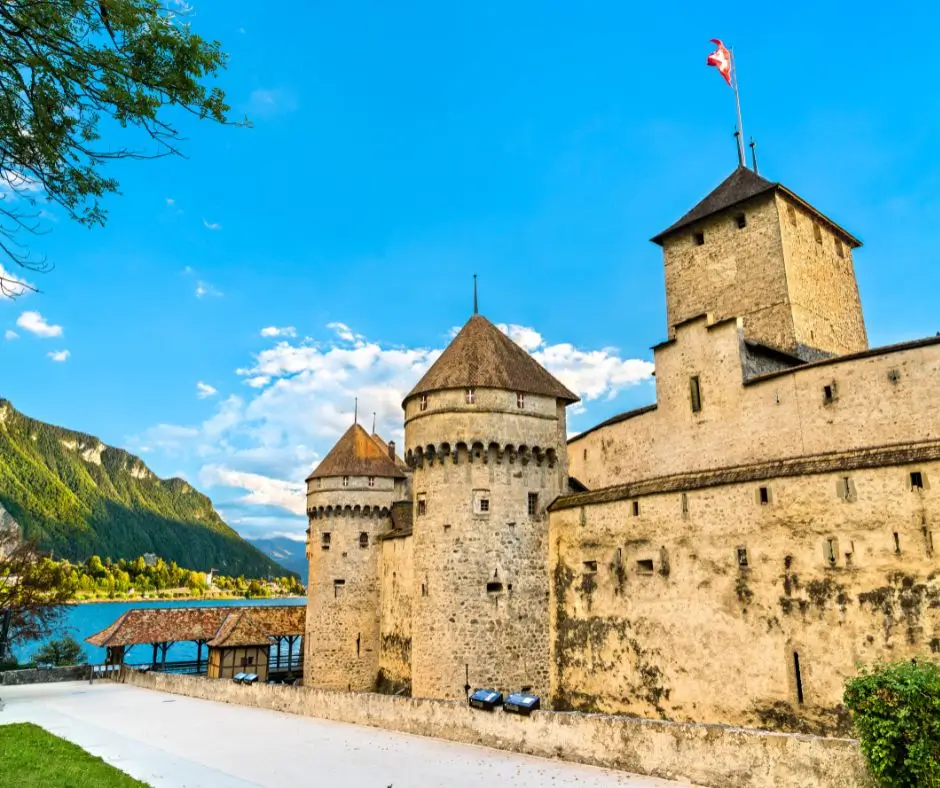
Villeneuve de Chillon: a Savoyard foundation (13th century)
In 1214, Count Thomas I of Savoy founded Villeneuve de Chillon, a new town located east of the castle, which would eventually replace the old village of Chillon. This foundation served a dual purpose: to house the growing population dependent on the castle and to control commercial traffic on the lake. Villeneuve became an agricultural and lakeside town, endowed with a charter and a toll, and drew its prosperity from trade and viticulture.
The old toll accounts of Villeneuve (1283–1293) are among the oldest preserved accounts of medieval towns in Europe, bearing witness to an economy structured around the lake and mountain roads. The church of Compengie, mentioned as early as 1166, was replaced by the current church, which became a parish church in 1228 and was converted into a temple in 1536.
Economy and daily life (13th–18th centuries)
Villeneuve's main sources of income were viticulture, fishing, and lake trade, with an active port connecting the Vaud shore to the other shores of Lake Geneva. The Villeneuve toll, levied on goods transported by water and road, was an important source of revenue for the Savoyard and later Bernese authorities.
The town was part of the Savoyard bailiwick of Chablais until 1536, then part of the Bernese bailiwick of Chillon, renamed the bailiwick of Vevey in 1734. It retained a local administration with trustees and councils, and served as a market center for the region.
The rise of tourism and seaside resorts (19th century)
In the 19th century, Villeneuve took advantage of the rise in alpine and lake tourism to transform itself into a seaside resort. The arrival of the railroad in 1858 and the construction of hotels and villas attracted a wealthy clientele, particularly from Britain and continental Europe.
Chillon Castle, now a museum, has become a major attraction, and Villeneuve is developing as a hub for visitors to Lake Geneva. This economic transformation marks the transition from a town of tolls and trade to a town of services and leisure.
Sources
-
Article « Villeneuve (VD) » dans l’Histoire de la Suisse (HLS-DHS-DSS), 2017.
-
Site officiel de la ville de Villeneuve (VD), section « Histoire ».
-
Dossier pédagogique « À l’abri des murailles : la vie d’un château à l’époque savoyarde », Fondation du château de Chillon, 2008.
-
Article « Chillon, château de » dans l’Histoire de la Suisse (HLS-DHS-DSS), 2005.
-
Site officiel du château de Chillon, sections « Histoire » et « Le château en quelques mots ».
5 Articles in this series:
The Military Fortress of Chillon – A 20th-century fortress (1941–1994) 4/5
Chillon and its region from 1900 to 1995 – Heritage, tourism, and memory 5/5