
THE COMPANY OF THE OLD GRENADIERS: HISTORICAL ORIGINS AND PRESENTATION
Histoire :
The corps of grenadiers, the elite of the Geneva militia, was created in 1686. In 1747, this local elite was reinstated after having lost all its honorary privileges for two years following a minor incident considered at the time as a rebellion.
In October 1749, fourteen grenadiers decided to meet alongside their professional activities and their service in the grenadier corps, with the aim of cultivating the bonds that united them. The Grenadiers’ Circle, which would later become the Society of the Old Grenadiers, was born. Today, it is one of the oldest patriotic societies in Geneva, distinguished by its motto: “Homeland–Family–Friendship.”
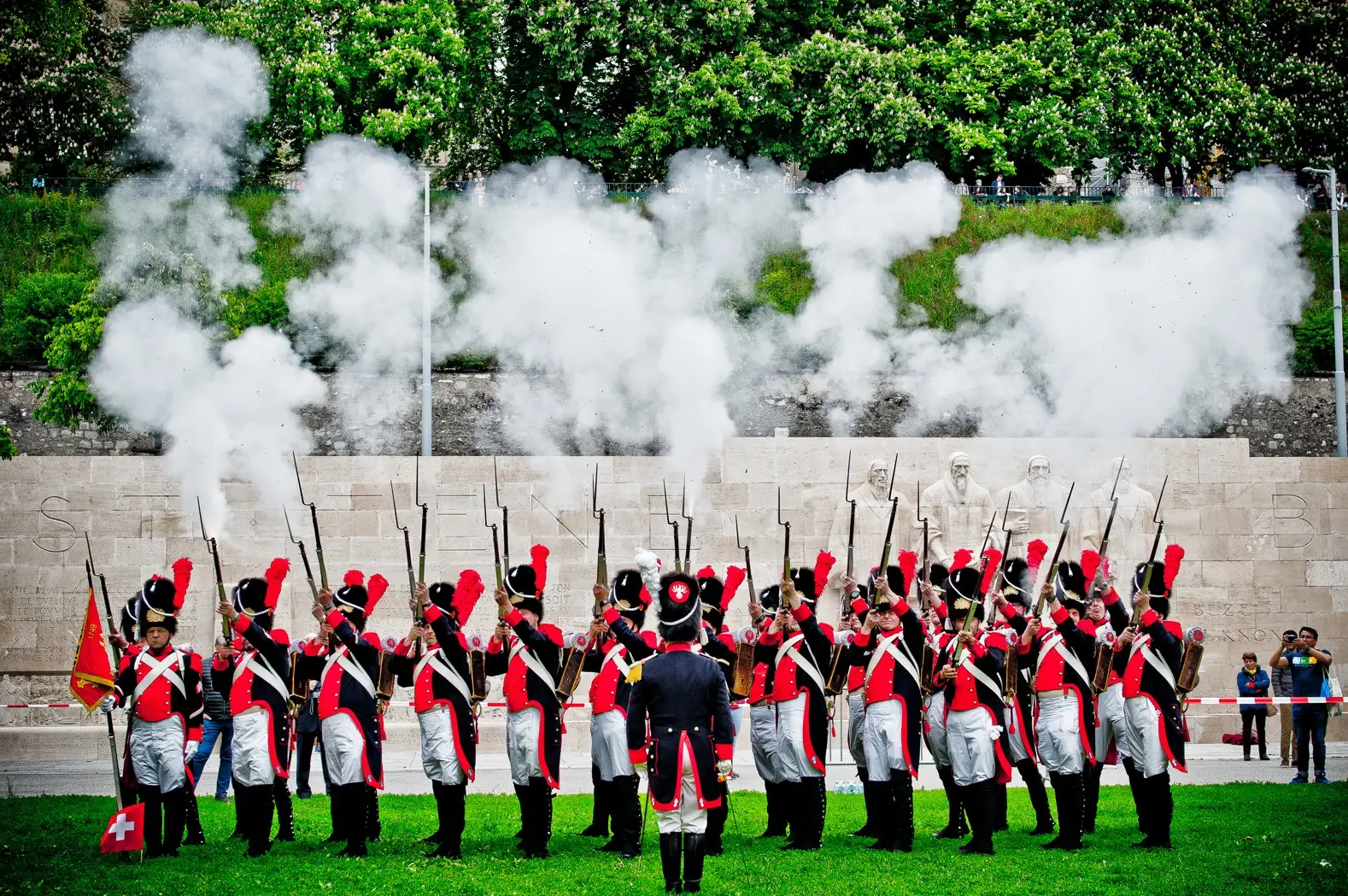
Until 1896, grenadiers never appeared in uniform. That year, the Swiss National Exhibition took place in Geneva, and seven members of the Society of the Old Grenadiers wore Geneva grenadier uniforms. The military section of the Society, which would become the Company of the Old Grenadiers, was then in the process of being established.
The uniform worn since then has undergone only minor modifications up to the present day. It symbolizes the period between the end of 1813, marking the Restoration of the Republic of Geneva, and the first cantonal military law of 1818. The city was emerging from a dark period of fifteen years of French occupation. The arrival of the Directory’s invading troops in April 1798 marked the temporary end of grenadier units within the militia. The latter, called the National Guard since 1796, retained its name and its division into four battalions but came under French influence. Geneva became the capital of the French Department of Léman.
Four companies of grenadiers were re-established in October 1801, alongside four companies of riflemen, as elite companies of the National Guard. They carried out nearly all the militia’s duties, including replacing the French garrison for guard service, supporting firefighters during fires, and escorting authorities during official ceremonies.
In September 1805, a new reorganization led to the creation of a Léman Legion, divided into six cohorts, two of which were based in Geneva. The city then had only two grenadier companies and two rifle companies on regular duty, while the sixteen fusilier companies were only mobilized in emergencies.
On December 30, 1813, it was mainly the two grenadier companies that were present at the departure of French troops and the arrival, a few hours later, of Austrian forces. From then on, Geneva’s grenadiers retained most of their uniform while quickly removing all French symbols: red Geneva lapels replaced the white ones of the French National Guard, French blue-white-red cockades were replaced by black cockades of the old Geneva regime (later officially replaced in 1815 by red and yellow Geneva cockades), and the imperial eagle plate on the bearskin cap disappeared.er On June 1, 1814, two weeks after the Austrian troops left, the two grenadier companies welcomed at Port-Noir the Swiss Confederates from Fribourg and Solothurn, symbolizing the beginning of the process that would lead to Geneva joining the Swiss Confederation the following year.

Today
The Company of the Old Grenadiers of Geneva, with around 120 men, takes part in patriotic, historical, and cultural events in Switzerland and abroad.
Since 1969, the Company has been reinforced by a marching band, giving it a particularly impressive presence. All pieces performed by the band and the drum corps are Swiss or Napoleonic marches.
The Company is organized in a military manner and commanded by a staff. It marches behind its commander in the following order: sappers with axes and white leather aprons, the flag and its guard, the drum major and drum corps, the bandmaster and musicians, and two sections of rifle bearers equipped with Model 1822 T bis rifles, following their respective officers.
The rifles, swords, and sabers, preserved in the Company’s arsenal, are authentic and were used on European battlefields, mainly in French armies. Even today, the Company’s drills and firing exercises follow the regulations of the period.
Upon request, for public or private events, the full Company or modular detachments (rifle bearers only, or with sappers, drummers, and possibly musicians) can be made available.
For further information:
