
Ulrich Wille. A Contested and Admired General
Auteur : Rudolf Jaun is Professor Emeritus of History at the University of Zurich and holds the Chair of Military History at the Military Academy of ETH Zurich.
With the general mobilisation decreed for 1er August 1914 and the Swiss army in need of a commander-in-chief, the Federal Assembly had to elect a general. The majority favoured Colonel Corps Commander Theophil Sprecher von Bernegg, chief of the general staff — a Graubünden aristocrat, introverted ascetic, but possessed of tremendous capacity for work.
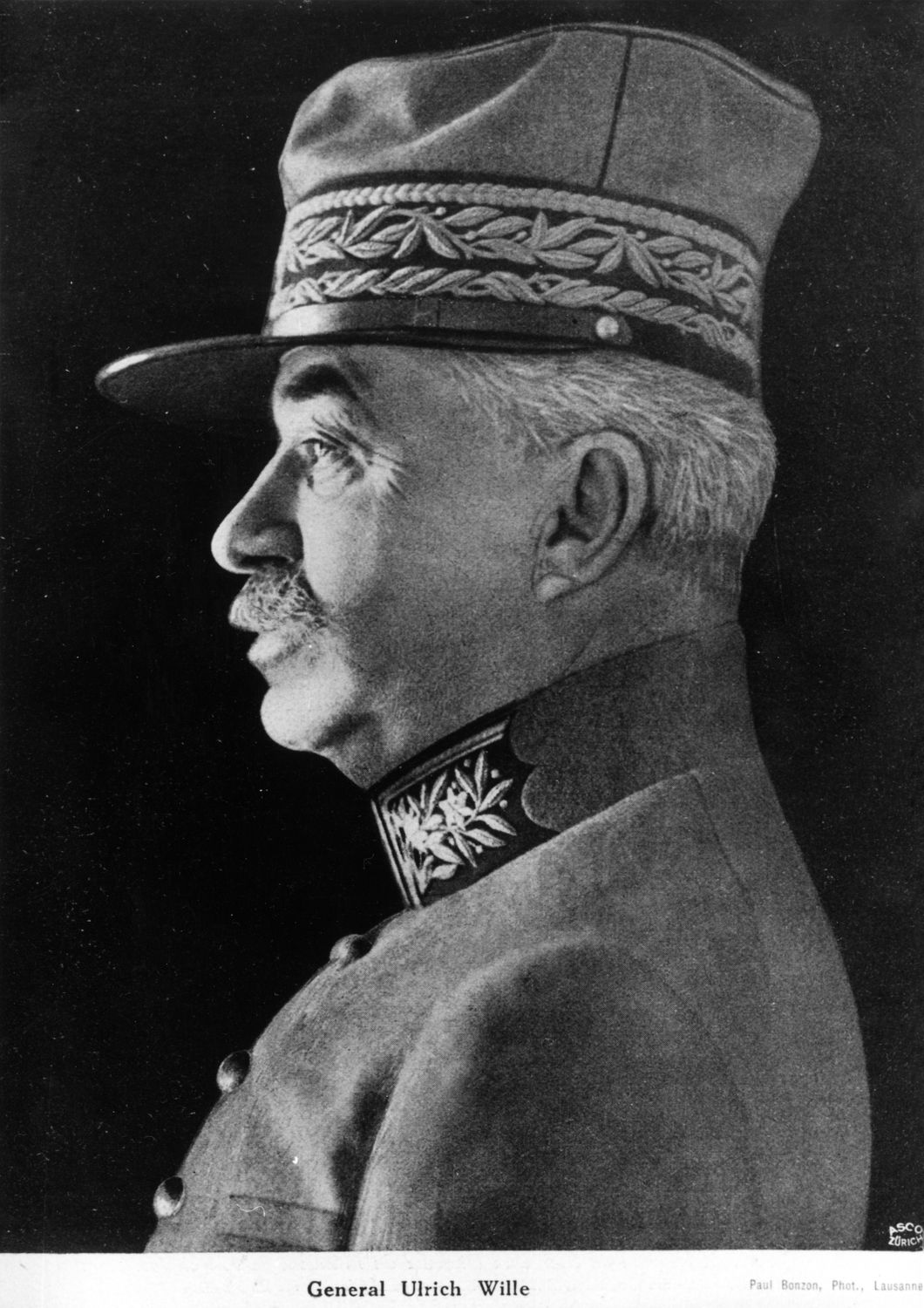
Facing each other, then, were a rigorous instructor with a feared pen, and a meticulous general staff officer. The Federal Council was determined to have Wille elected, judging him perhaps capable of bringing the militias, within a few months, to a standard where they would not fail "before the enemy" — and because he was a soldier to his core with strong ties to Kaiser Wilhelm II and the German chief of the general staff, von Moltke. Wille knew this, and he wanted to become general. On the afternoon of 3 August, when views within the parliamentary groups had already been formed and Sprecher had been asked to stand ready for the oath of office, Wille took a deep breath and, accompanied by his adjutant, made his way to Sprecher's residence in Kirchenfeld in Berne to request a meeting. He pressed Sprecher to stand aside in accordance with the Federal Council's wishes, while Sprecher himself would become chief of the general staff — a role for which he was better suited. Sprecher graciously agreed. It then fell to radical Federal Councillor Arthur Hoffmann — himself a colonel and ardent supporter of Wille — to bring his party's parliamentary group around. Standing on a table, he delivered a rousing speech and secured the radicals' about-face: the way was clear for Wille. The Federal Assembly elected him commander-in-chief of an army undergoing its first full mobilisation.

Training and Career
Born in 1848 in Hamburg, Ulrich Wille arrived in 1851 with his parents at Feldmeilen on the shores of Lake Zurich. His father, a liberal disillusioned by the failure of the 1848 revolution, purchased the Mariafeld estate there. His mother, Eliza Sloman, daughter of a shipowner, brought some money and considerable culture to the household. She was a writer. His father was a writer and journalist. After a few years of primary school, his parents took charge of their child's education themselves; he would later join the Zurich cadet corps. At 17, having passed the entrance examination, he began studying law at the University of Zurich. Forced to leave after a sabre duel, the duellist continued his studies in Halle, then Leipzig, then Zurich again. At 21, he was awarded a doctorate in Heidelberg. After his recruits' school in the artillery, he served as a lieutenant during the Franco-Prussian War. In 1871, he decided to pursue a career as an instructor officer in the Swiss army. He was posted to the 1er st Prussian Guard Artillery Regiment and the Artillery and Engineer School in Berlin. The following year he trained at the Federal Instructors' School before beginning his career at the Thun military training ground. He was never admitted to the general staff, though his name had been put forward. That same year, 1872, he married Konstanze Maria Clara von Bismarck, daughter of a Württemberg general. Three characteristics set Wille apart among Swiss military instructors. First, he held a doctorate in law. Second, his family background and education had given him strong affinities with the German intellectual world. And third, his marriage had further deepened his ties to German culture and way of life. In the Wille household, proper German was spoken — not dialect.
As an instructor too, Wille sought from the outset to distinguish himself: he continually proposed improvements and developed a personal teaching style that engaged the officers and non-commissioned officers of batteries and companies directly. Until then, officers and NCOs had received troops who were already trained and had taken up their command roles within a still highly formal framework. Increasingly, Wille used the press to make his views known. This drive to reform military socialisation and training reached its peak when he acquired a journal, the Zeitschrift für Artillerie und Geniesecuring himself a platform. If a refresher course had been conducted carelessly, it would invariably attract a commentary from Wille.
Head of the Swiss Cavalry: From Veneration to Dismissal
Wille's results were so impressive that in 1882 the Federal Council appointed him chief instructor, and in 1892 chief of the cavalry arm. Within a few years, he succeeded in turning the militia cavalry into an elite force within the Swiss army. Among the educated bourgeoisie and the leading classes of business, many young men aspired to become cavalry officers and to take on the prestige and authority that arm enjoyed, while prosperous farming communities provided many NCOs and dragoons who completed their service with their own horses. Surrounded by a rapidly growing reputation, Wille began writing treatises on authority in the army and on the training of officers and troops. He cast himself as a plain military expert, and in his pamphlets he targeted militia officers whose careers were often motivated by social and political reasons alone: his contempt was summed up in the label "political colonels." As chief of arm too, he insisted on his prerogatives — going so far as to provoke his own dismissal in 1896, following the promotion — unjustified in his view — of a cavalry instructor, Traugott Markwalder. By repeatedly insisting that only formal drill could instil discipline in citizen-soldiers, and that only a heightened distance and difference in rank could give citizen-officers authority over militia soldiers, he had in the meantime made enemies who were beginning to form a "national path" in opposition to the strictly military orientation of his "new path."
So Wille found himself without a position. Settling at the family estate of Mariafeld, he did what he had always done well: write. He published articles in various periodicals and stood as a candidate in elections to Zurich City's executive and to the National Council — without success. Military matters remained closest to his heart, and he drew up a draft "military constitution of the Swiss Confederation," published in 1899.

The Relaunch of Colonel Wille
Among the cavalry officers, Wille had solid backing. His most committed supporters, who shared his vision of a disciplined citizen army under authoritarian command, rallied to secure his return to the upper echelons of the Swiss army.
Key figures in this inner circle included Lieutenant-Colonel Fritz Gertsch, an instructor officer; Ferdinand Affolter, professor of military science at the Federal Polytechnic in Zurich; and Lieutenant-Colonel of the general staff Emil Richard, secretary-general of the Zurich Chamber of Commerce. In a series of articles published in the Zürcher Post that became known as the "hydra" articles, Richard launched attacks against the leading figures of the "national path" — the hydra against which Wille was at war — by highlighting irregularities which, though minor, nonetheless forced most of those implicated to resign. By 1901, Wille had already been reactivated with the rank of militia divisional colonel. In 1903 he became a lecturer in military science at the Federal Polytechnic in Zurich — where since 1878 the subject had constituted its own department — and in 1907 a full professor. In 1904, a riding accident suffered by the incumbent allowed him to succeed as commander of the 3e rd Army Corps, simultaneously attaining the rank of colonel corps commander. Since 1901, Wille had also been editor-in-chief of theAllgemeine Schweizerische Militär-Zeitung (ASMZWithin fewer than five years, with the help of powerful allies, he had managed to occupy all the key positions needed to assert interpretive supremacy in military matters. The "new path" charted by Wille prevailed definitively in 1907, when citizens approved the draft of a new military organisation law against which the left had secured a referendum. In 1908, Wille set out the objectives of military training, thereby consolidating the legitimacy of his vision of instruction and combat leadership. As commander of the 3e rd Army Corps, he ensured the systematic application of formal drill and the rigorous strengthening of officers' authority. In 1912, when Emperor Wilhelm II visited Switzerland for military reasons (the Schlieffen Plan), Wille directed the "imperial manoeuvres" and strengthened his ties with the German general staff and the imperial family.
Wille, a fighter to his core, was elected on 3 August 1914 as commander-in-chief of the Swiss army, with the rank of general.
Rudolf Jaun : Wille. Un général contesté et admiré, Gollion 2024 (infolio éditions)
