
School trip to the Fort de Chillon Museum: understanding the National Redoubt
During World War II, Switzerland retreated to its mountains to defend its independence: this was known as the National Redoubt. Discover why the Swiss army concentrated its forces in the Alps, how this choice protected Switzerland, and why the Redoubt became a national myth.
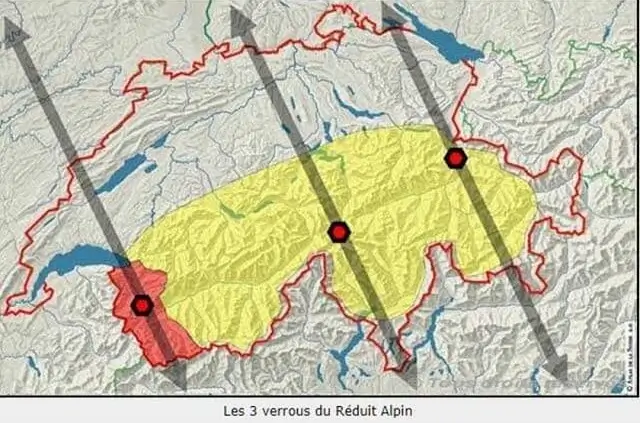
A defense plan in the Alps
In June 1940, after France surrendered and Switzerland was surrounded by Germany, Italy, and their allies, General Henri Guisan opted for a radical strategy: concentrating most of the forces in the central Alps, around the Gotthard massif, to establish an impregnable defensive position there.This plan, known as the National Redoubt,involved partially abandoning the Swiss Plateau and the Jura to the invaders, waging a delaying guerrilla war there, while the regular army entrenched itself in the Alpine heights, where the steep terrain, narrow passes, and fortifications made any conquest extremely costly. Thousands of soldiers, equipment, and even factories were transported to these rocky bastions, with mined tunnels, bridges ready to be blown up, and artillery forts covering vital routes.
A strategy of deterrence
The Réduit did not aim for total victory, but rather deterrence through attrition: making invasion so costly in terms of lives and equipment that it would become unacceptable to the aggressor, thereby preserving Swiss sovereignty. Symbolized by the Grütli speech on July 25, 1940, this strategy culminated during the war with structures such as the Saint-Maurice fortress, equipped with heavy artillery and autonomous underground tunnels. After the Allied landings in Normandy (June 1944), the threat faded; Guisan ordered a gradual return of troops to the Plateau for a more balanced defense, while keeping the Réduit on alert until the end of the conflict.
In connection with the Fort de Chillon Museum
The Fort de Chillon Museum embodies this national redoubt: dug in 1941 in the strategic bottleneck of Lake Geneva, it blocks access to the Chablais region and protects the Simplon route, echoing the major Alpine bastions. Interactive games and tactical models allow visitors to simulate strategy, showing how a fort like Chillon—with its 7.5 cm cannons and mined positions—was integrated into the overall deterrence network.
For teachers
This article serves as a basis for preparing for a school trip to the Fort de Chillon Museum and does not claim to be exhaustive. It can be supplemented in class by studying the National Redoubt, the militia army, and Switzerland's role in 20th-century Europe.
Sources
-
Musée Fort de Chillon, Office tourisme Lausanne, 2025
Discover themes for a school trip to the Fort de Chillon Museum
School trip to the Fort de Chillon Museum: castle and fort, a strategic continuity
School trip to the Fort de Chillon Museum: General Guisan and the Swiss resistance
School trip to the Fort de Chillon Museum: what is a citizen-soldier?
School trip to the Fort de Chillon Museum: understanding the National Redoubt
School trip to the Fort de Chillon Museum: Swiss neutrality in times of war (concept for students)